
Mobile County Past Resident Sources
Each source answers a distinct question about past residents. The Revenue Commission parcel card points to today's assessed owner and stable parcel identifiers. Probate instruments document legal transfers. Directories and the federal census add occupants who may never have owned the property. Sanborn maps describe the structure and street layout, while cemetery, obituary, and probate material can close a person's trail. Starting with the right source for the target era prevents a modern address search from becoming the only test.
| Source | Years it covers | Where held | What it shows |
|---|---|---|---|
| Recorded documents | 1813-present | Mobile County Probate Court | Ownership and encumbrance chain |
| Modern deed index | 1984-present | Landmark WEB | Searchable transfer metadata |
| Online document images | September 1995-present | Landmark WEB | Instrument text when available |
| City directories | 1837 onward, with gaps | MPL, McCall, ADAH | Occupant, work, and address clues |
| Federal census | Public schedules through 1950 | NARA and library sources | Household snapshots |
| Sanborn maps | 1885-1956 selected sets | Library of Congress and local collections | Building footprint, use, and street layout |
| Burial records | 1836-1995 and local series | FamilySearch and Municipal Archives | Death, burial, cemetery, and plot clues |
Choose the first record by date. A late twentieth-century search can begin online. An early deed chain may require the separate historic index, then the Records Room. A person who rented or stayed with family may surface only in a directory or census. No source should be stretched beyond what it was made to record.
Start Mobile County Previous Residents
Begin at the Mobile County Revenue Commission Property Search. Search the street address, then record the current owner, key or parcel number, legal description, subdivision, situs address, and mailing address. Situs means the physical location of the parcel. The mailing field is where tax correspondence goes, so it may name an estate, business, or owner who lives elsewhere. Neither field alone proves who occupied the property.
The legal description is the durable bridge. Street numbers and labels can change, but a subdivision, lot, block, or metes-and-bounds description can follow the land through older instruments. Homestead status may support owner occupancy, yet it does not name all household members. Alabama also assesses ownership as of October 1, so a later sale can remain shown under the seller for that tax year, sometimes with the buyer listed “care of,” before the next update.
Use the county GIS map to check the parcel's shape and location, but treat it as approximate geometry rather than a legal survey. Carry the parcel identifiers into every later step. They help keep the trail on the same land when two owners share a name or a road has been relabeled.
House-history rule. An assessed owner, a taxpayer, an occupant, and a postal recipient can be four different people at one Mobile County address.
Mobile County Past Resident Deeds
The Mobile County Probate Court records search routes modern and historic deed work into Landmark WEB. Registration and email validation are required for the free index. A name search uses last name then first name with no comma, and it can be broadened with Starts With or Contains. Document type and date fields can narrow a long result list. Images cost ten cents per page plus the stated five percent charge, and purchased pages remain available for download or print for ten days. A $125 monthly option is intended for high-volume access.
- Find the current owner's purchase deed, where that owner appears as grantee, meaning the receiving party.
- Confirm the parcel by legal description, book and page, instrument number, and record date.
- Take the seller, or grantor, and search that person as grantee in the earlier purchase.
- Repeat the transfer one link at a time, checking land identity at every step.
- At the online cutoff, move to the historic direct and reverse index, deed books, or Records Room.
- Grantor and grantee
- The grantor gives or transfers an interest; the grantee receives it.
- Chain of title
- The linked sequence of recorded transfers for the same land.
- Legal description
- The formal land description that stays useful when a street label changes.
- Instrument
- A recorded document such as a deed or mortgage, identified by book/page or a modern number.
Landmark can search by Name, Document, Book and Page, Record Date, Instrument Number, or Legal description. For prior owners of a subdivision property, a partial or full subdivision name may help. Results allow column filtering, but a matched name still needs the land details before it joins the chain.
Bridge Mobile County Resident Cutoffs
The online chronology is layered. The modern computer index covers real property from 1984 forward, and stated online image coverage begins in September 1995. A separate courtesy direct and reverse index covers 1813 through 1983. It is an index to the old books, not the official recorded instrument. If the entry or image does not settle the identity, inspect the record at the Probate Records Room, 151 Government Street Annex, Monday through Friday from 8 a.m. to 5 p.m. Records staff can be reached at 251-574-6070.
The Probate Court's historic index instructions are worth seeing before a search:
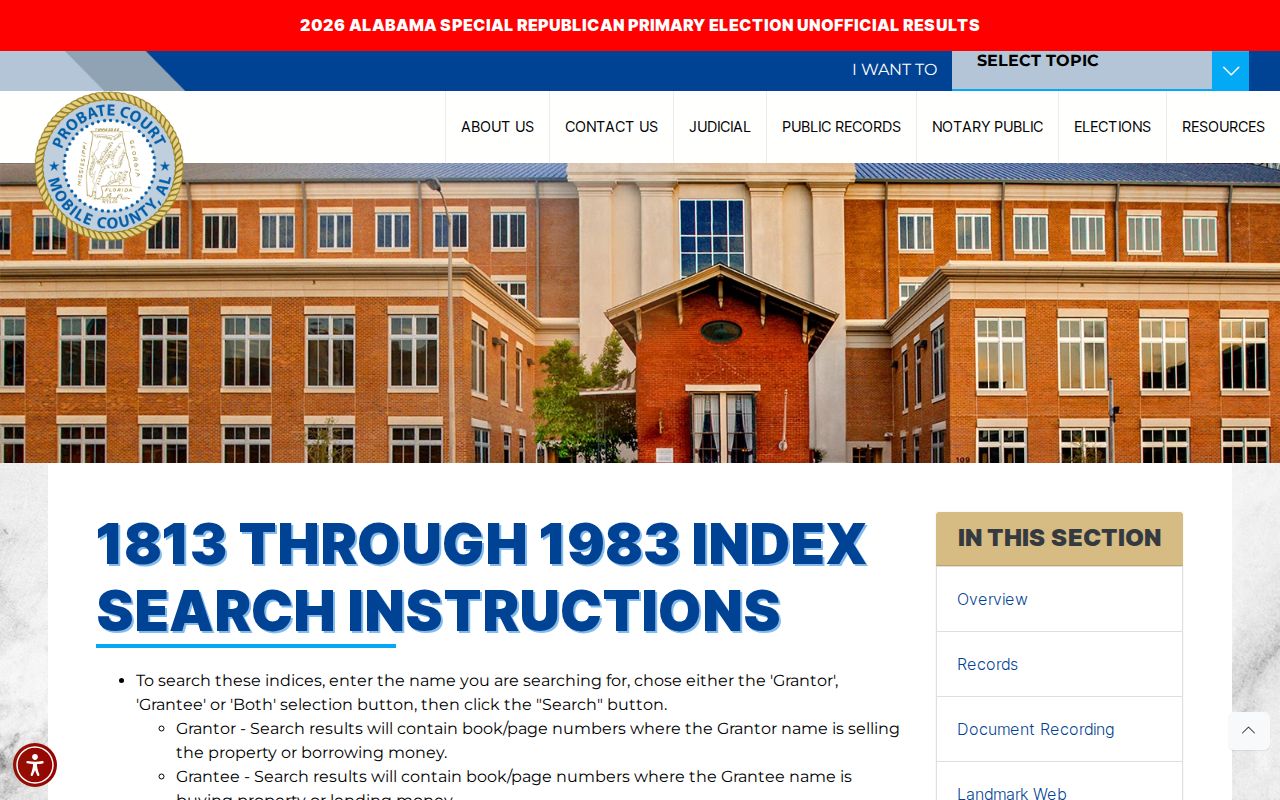
The screen reflects the older grantor and grantee method needed to move a chain beyond the modern index.
A two-digit year can be ambiguous in this historic system. Probate supplies book-label clues: deed books numbered 93 and above are twentieth century, miscellaneous books Q through Z and numbered books are twentieth century, mortgage books 41 and above are twentieth century, and books without a letter date from September 1958 or later. Lettered image names generally point to 1813-1958, while numeric-only names indicate 1958-1983. Record the exact label and image reference before moving on.
Note: Landmark searches more than five million documents, but a large index does not replace the official book or Records Room inspection.
Mobile County Records Beyond Deeds
The Probate Court's archival records inventory reaches beyond deeds. It includes maps and plats from 1872, marriage material, wills, estates, guardianships, election records, translated records from 1715-1841, and other historic books. Wills begin in 1812 and deeds in 1813. Probate also notes estate claims filed in Recording through July 1, 2013. These records can explain how a parcel moved after death or why a family name appears in later property papers.
The official Probate inventory shows how the court separates record groups and formats:
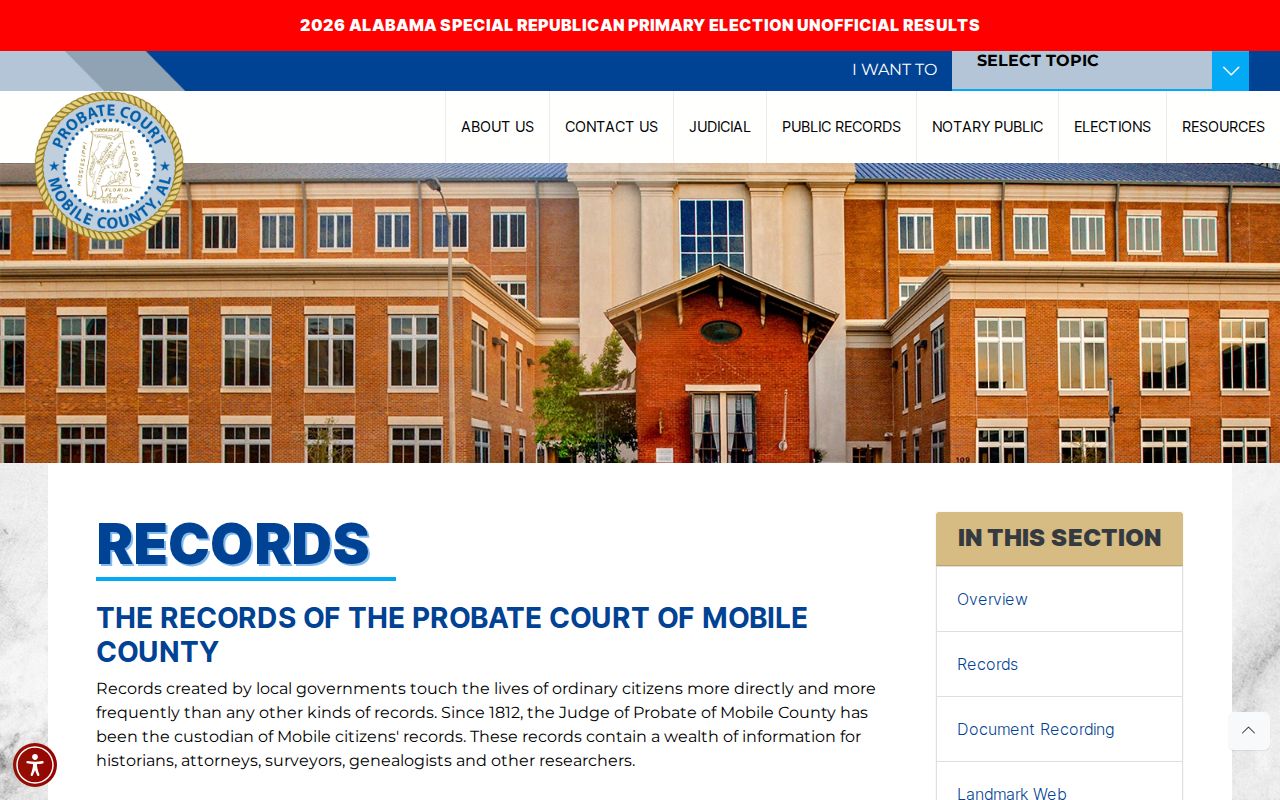
That coverage page is the place to choose the right division before calling, visiting, or filing a narrow request.
Access also has limits. Adoption and mental-health files and most judicial documents are not online. Living wills and military discharges are blocked except for eligible people. The court says staff will make public records available, but staff need not locate, index, or copy a broad research project and will not email or save records to portable media under its inspection rules. Bring precise names, dates, book references, and record groups.
Add Mobile County Past Residents
Ownership is only half the address history. Mobile directories begin in 1837 and can list a person's residence and work, while later reverse or criss-cross sections can arrange names by street address. The exact reverse-directory editions are not fully enumerated online, so confirm a year with Mobile Public Library, McCall Library, or ADAH. The detailed collection runs and reading keys belong to the Mobile County city directory collections.
Pair the directory trail with the nearest public federal census schedule. As of 2026, the latest public decennial census is 1950 under the 72-year release rule. The directory can bracket a move between census years; the census can add ages, relationships, and other household members who never received their own directory line.
- Find the address or a known occupant in the closest available directory before the target date.
- Compare the next earlier and later editions, recording every shift in number, street term, and name.
- Open the nearest public census and confirm the household with two anchors, such as name plus age or address.
- Return to annual directories to narrow the span of arrival or departure.
- Use newspapers, probate, death, and burial records to test why a person disappears.
Do not fill an absent year from memory or assume the directory run was annual. A missing entry may reflect a move, death, omission, spell variant, household listing practice, or an unavailable edition. Keep “not found” separate from “not present.”
Map Mobile County Past Resident Houses
Sanborn fire-insurance maps can show what happened to the building while the people trail changes. Available Mobile sets include 1885 with 28 sheets, 1891 with 38, 1904 with 103, 1922 additions, 1924 volume one, 1925 volume two, and republished 1956 volumes for later areas. They can reveal a footprint, construction material, use, lot relation, street layout, and additions. They do not name each past resident.
The 1925 suburban sheets extend into Crichton, Toulminville, Prichard, Whistler, West Mobile, and Spring Hill. The republished 1956 maps extend farther into Chickasaw, Plateau, and related areas. For downtown homes east of Broad Street, Mobile Public Library's Historical Homes Survey adds another local layer. Match a map sheet to the legal parcel and directory address before treating a drawn structure as the same building.
Old address language can defeat a direct search. The 1837 grid numbered streets parallel to the river from Front No. 1 through Scott No. 18. North and south cross streets also used a numbered scheme based around Dauphin. Preserve the old wording and compare it with a period map. No firm citywide renumbering chronology was found, so the legal description is safer than an invented conversion date.
Request Mobile County Address Records
When the online chain stops, use a specific repository request. The City of Mobile Municipal Archives has people-rich cemetery deed indexes, deed receipts, lot-sale books, and burial reports, along with other municipal records. Its burial reports from 1920-1973 may supply a name, age, work, birthplace, death and burial dates, cemetery, mortuary, lot, plot occupants, and section owner, though some years are incomplete.
The Municipal Archives information request offers a direct channel for a focused subject, address, and date span:
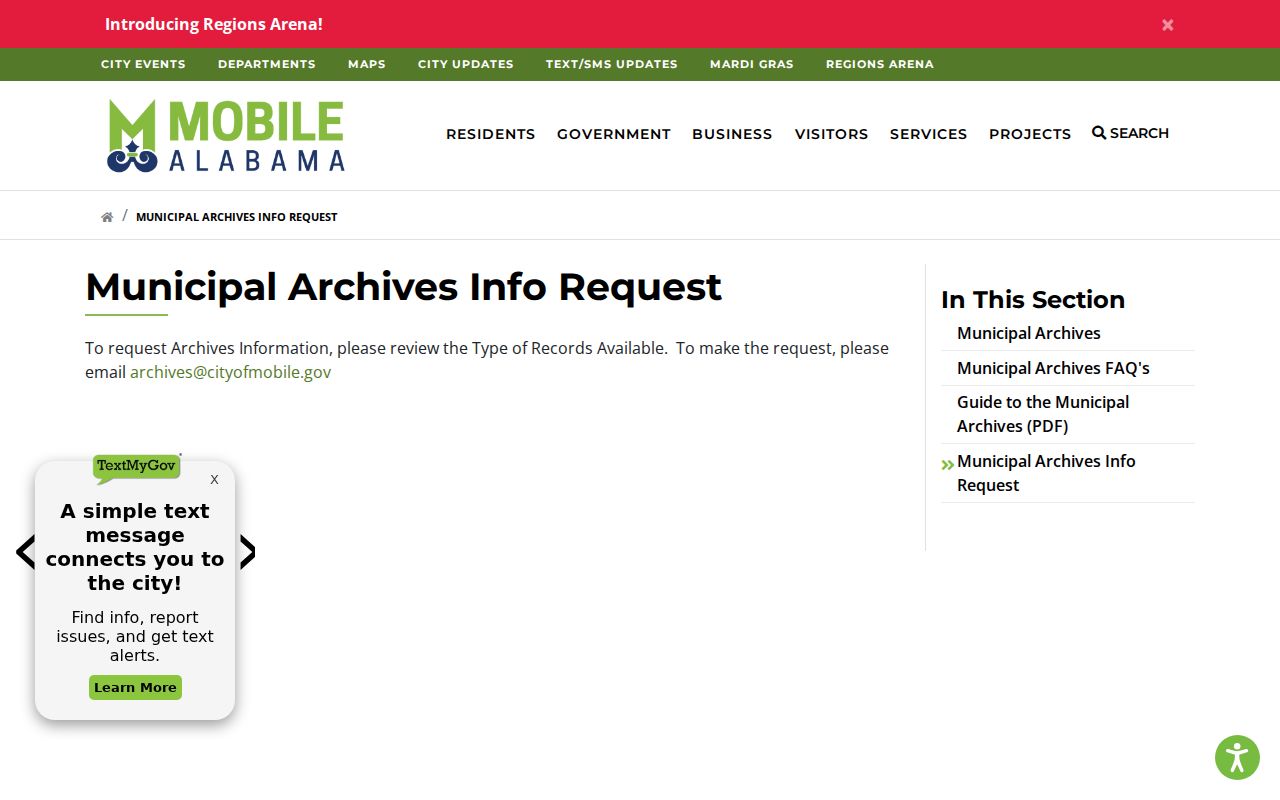
The request route is most useful after deeds, directories, or maps have supplied a precise name and period.
For state-held material, ADAH remote research services provide another fallback:
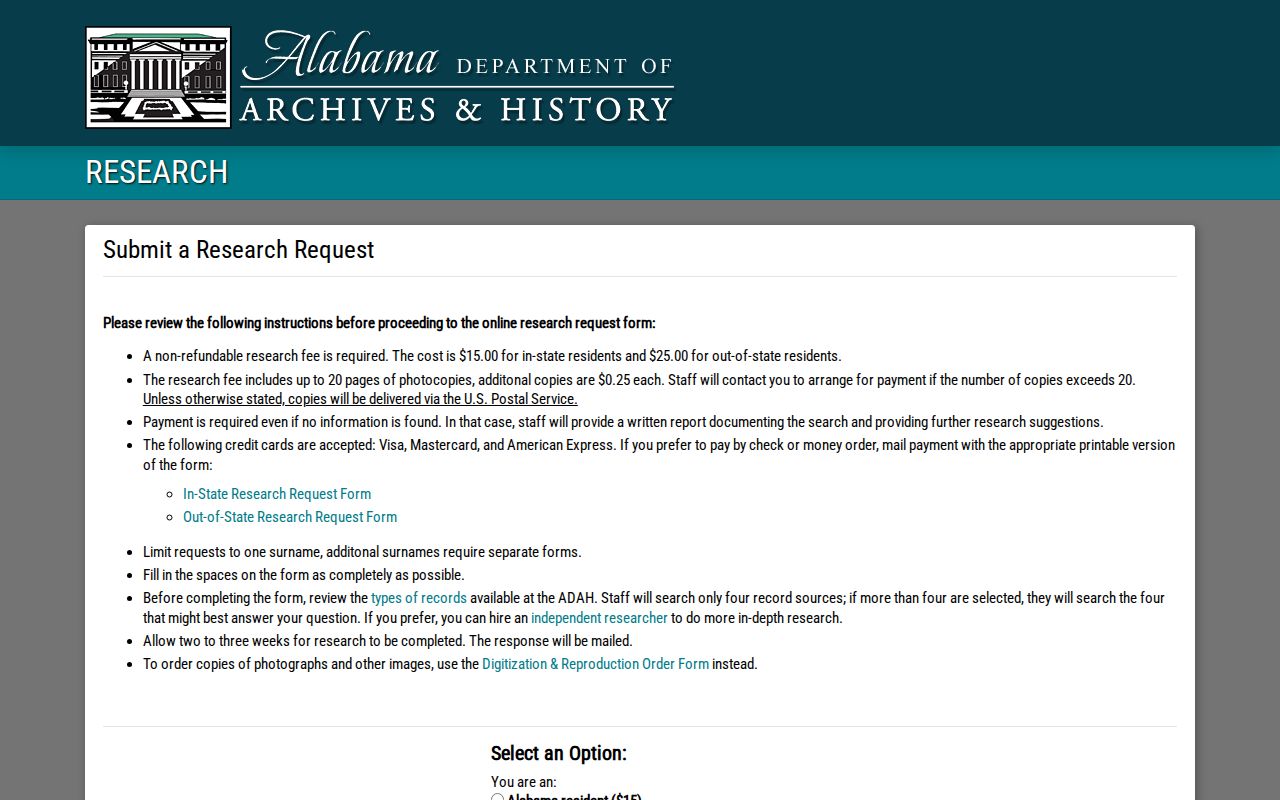
The state service can help route an exact directory year or record group when travel is not practical.
If neither archive holds the item, call the direct custodian, visit the public counter or terminal, send the record-specific form, and only then use the broader city, county, or state open-record process for an identified existing series. A portal's silence is not proof that the record never existed.
Close Mobile Previous Resident Trails
A person who vanishes from an address sequence may have died, moved, changed name, joined another household, or simply been omitted. Mobile's burial and probate sources can test the first possibility. Magnolia Cemetery interment cards cover 1836-1995 and search first name, last name, birthplace, and birth year across 32,865 browse images. Municipal Archives holds Magnolia Cemetery deed and receipt series, lots sold from 1838-1861, purchases from 1888-1942, and all-city burial reports from 1920-1973.
These sources answer different questions. An interment card identifies a burial. A cemetery deed can identify a lot owner. A city report may add mortuary, fees, or plot data. Probate files can show an estate or transfer after death, and newspapers may add an obituary or notice. Match name, date, kin, and place before joining the records.
Lawful use. Research past residents for family history, property history, and personal curiosity, and never use an address trail to stalk or harass a living person.
Mobile County's Unusual Record Depth
Mobile County was created in 1812, while Mobile began in 1702 under changing French, Spanish, British, and United States rule. That layered past explains colonial, translated, Catholic, municipal, and county sources that predate many standard Alabama books. Courthouse fires occurred in 1823, 1840, and 1872, but the evidence does not identify every lost series. Never turn those dates into a claim that all earlier records were destroyed.
Probate's Archives Section began in 1989 after historic and colonial records were found in a courthouse attic. State staff had begun microfilming local Probate records in 1948, and the court formed its Micrographic Section in 1958. In 2019, it reported digitizing all microfilm images and direct and reverse name indexes. That preservation work helps explain why a Mobile County previous residents search can reach much farther back than the modern web interface suggests.
World War II creates another notable layer. Roughly 89,000 workers arrived between 1940 and 1943, and county population rose by more than 60 percent. Shipyard newsletters, photographs, directories, and neighborhood records can therefore be vital for a household that appears briefly. McCall Library's nearly complete Fore & Aft employee newsletter and large ADDSCO photo holdings can place people in that industrial and community context.