
Mobile County Directory Runs
Mobile's historical shelf begins unusually early. The Alabama Department of Archives and History directory inventory, or ADAH inventory, lists Mobile volumes in microfiche, print, and microfilm, while the Mobile Public Library says its directories reach back to 1837. The exact ADAH inventory matters because the run is not continuous. Omitted years show a gap in that repository's captured holdings, not proof that no book was issued. Later titles also widen from the City of Mobile to Mobile-Baldwin Counties and Mobile County, which helps with households outside the old city core.
| Collection | Years represented | Where held | Access |
|---|---|---|---|
| Early Mobile directories | 1837, 1838, 1839, 1842, 1844, 1855, 1856, 1859 | ADAH | Microfiche, with selected print counterparts |
| Mobile print sequence | 1837 through 1995, with listed gaps | ADAH | On-site print volumes |
| Later county-area titles | 1997, 2000-03, 2005-07 | ADAH | Print; title and coverage vary |
| Mobile and nearby directories | Back to 1837; exact editions require confirmation | Mobile Public Library | Local History & Genealogy |
| Mobile and North Suburban runs | Most 1956-91 volumes; nineteenth century on microfilm | McCall Library | Appointment and staff preparation |
The ADAH list is the soundest year-by-year inventory in the research. Its print holdings include long stretches such as 1869-83, 1884-98, 1905-16, 1935-42, 1944-56, 1958-69, and 1971-92, but scattered missing years remain. Call before traveling for one edition. A catalog check can also reveal whether the needed community falls under Mobile, Prichard, Mobile North Suburban, or a county-area title.
Mobile County Directory Reading Rooms
The most direct local stop is Mobile Public Library Local History & Genealogy at 753 Government Street. The branch is open Monday through Saturday from 9 a.m. to 5 p.m.; its research number is 251-494-2190 and email is mainlhg@mplonline.org. Its city directory shelf sits beside census, church, newspaper, death, burial, and probate material, so a name found in one volume can be tested against another local source.
The Doy Leale McCall Rare Book and Manuscript Library in the Marx Library is another strong route. It holds most twentieth-century Mobile city directories and nineteenth-century runs on microfilm, plus many Prichard and Mobile North Suburban volumes from 1956 through 1991. Contact staff at 251-341-3900 or mccalllib@southalabama.edu before a visit. Some early files need preparation, and not every finding aid is online.
Remote researchers can ask a librarian to confirm a year or title, then use ADAH or McCall for the format that fits. This matters when one repository has print but another has film. It also avoids assuming that a broad shelf description guarantees a specific edition.
Start with the library's official branch description and view of the research desk:
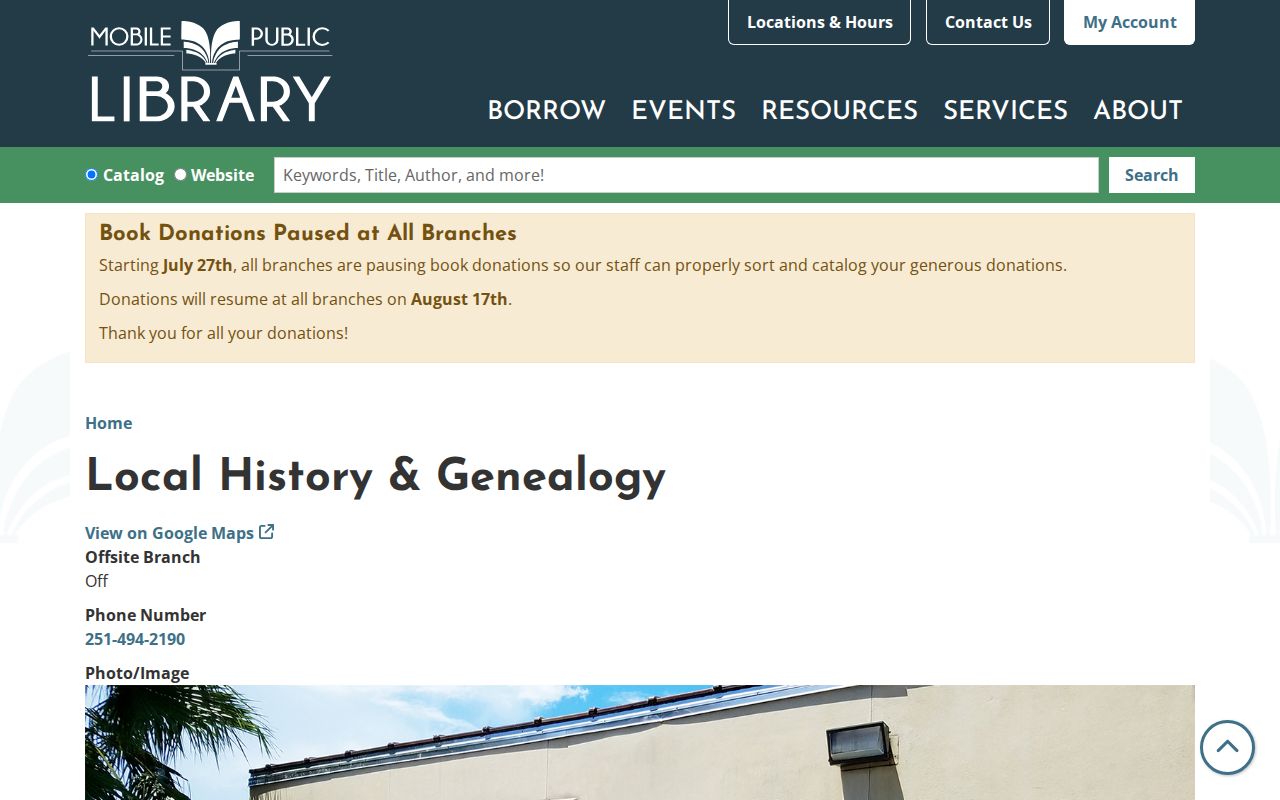
The branch page confirms the contact channel and hours that make an edition check possible before an in-person search.
Read Mobile County Directory Entries
An 1837 entry can hold far more than a name. The book may give an occupation or public office, a firm or business site, a residence, widowhood, and a cross-street location. It also used historical racial and free-status notation. Those labels must be read in their period context and transcribed with care. A blank residence field means the publisher did not supply one. It does not prove that the person had no home in Mobile County.
| Name | Surname and given name or initials, which may vary by edition |
|---|---|
| Work or role | Occupation, public office, firm, or business location |
| Residence | Street or cross-street description, sometimes separate from work |
| Family clue | Widow notation or another brief household marker |
| Status notation | Period labels that can identify free men or women of color |
The key is essential. In the early volume, “c.” means corner, “n.c.” means near corner, “r.n.c.” means residence near corner, “b.” means between, and “r.” means residence. Government may appear as “Govt.” Photograph or copy the abbreviation page whenever possible. Without it, a short mark can be mistaken for part of a street name or a personal initial.
- Criss-cross directory
- A later address-first section that groups entries by street and house number rather than surname.
- Householder index
- A listing focused on the named person associated with a household address, not a complete roll of everyone present.
- Abbreviation key
- The publisher's legend for shortened streets, occupations, residence marks, and status labels.
Mobile County Directory Publishers Before Polk
Early Mobile County city directory research should not begin with the assumption that every volume is a Polk directory. H. M. McGuire and T. C. Fay published the 1837 Mobile Directory. T. C. Fay and R. R. Dade appear in 1838-39, R. P. Vail with Dade and Thompson in 1842, and Dade and Thompson in 1844. Rowan's appears in 1850-51. Farrow & Company published editions in 1861 and from 1871 through 1876. R. L. Polk is confirmed in twentieth-century material, including digitized 1905 and 1920 editions.
Publisher changes affect title searches and arrangement. Search library catalogs by place, year, and publisher, not only by the phrase “city directory.” If a surname search fails in a scan, browse the alphabetical pages near likely spellings. Type, print quality, and optical character recognition can all hide a correct entry.
Note: A missing catalog year marks an evidence gap, so confirm the shelf before concluding that Mobile County had no directory that year.
Search Mobile County Directory Companions Online
The Mobile Public Library Digital Collections does more than place old books on a screen. It brings together city atlases, Mobile death records, Clotilda files, 1918 influenza material, manuscripts, photographs, postcards, fire and police history, and digital yearbooks. The search accepts Keyword, Boolean, and Exact modes. Filters can narrow results to an Item, File, Collection, or Exhibit, while Advanced Search applies to items.
Use a city directory name as the starting term, then test the address, firm, or organization found beside it. Cite the item title and collection in research notes, not just the collection homepage. A yearbook photograph or a death-record item may help distinguish two people with the same initials, though each identification still needs a second anchor.
The library's digital search surface shows how these companion collections are organized:
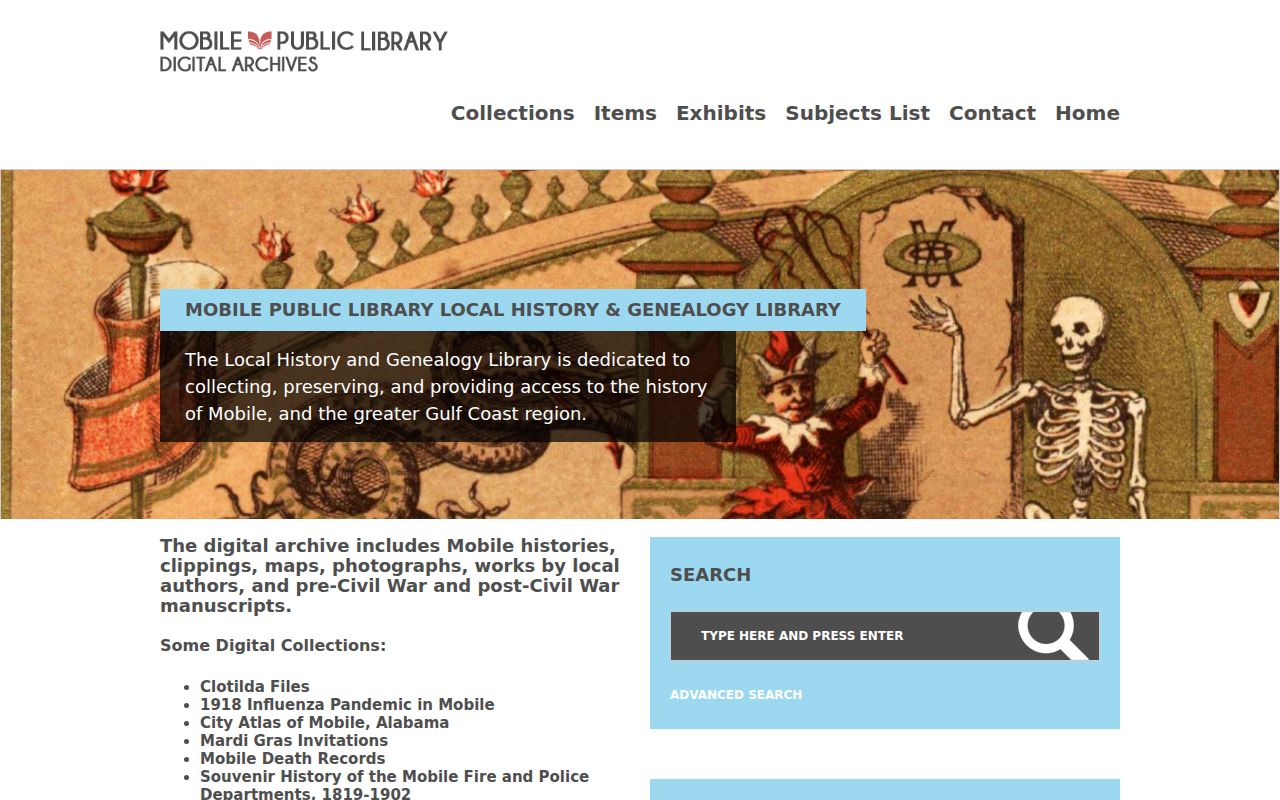
The filters make it possible to move from a broad family name to a specific yearbook, map, photo, manuscript, or death-record collection.
Trace Mobile County Directory Households
A single entry is a snapshot. A sequence can show when a person arrived, moved, changed work, became widowed, or disappeared from the published record. Begin with a confirmed name and year. Record the whole line, including initials, occupation, firm, residence, and marks. Then compare the closest earlier and later editions rather than jumping a decade. Adjacent years can bracket change more tightly.
- Find the first well-supported alphabetical entry and copy every field plus the volume year and page.
- Check nearby editions for spelling, initials, work, and address changes.
- Use an address-first or criss-cross section when the edition has one, noting that exact years are not fully listed online.
- Pair the run with the 1950 or earlier federal census. As of 2026, 1950 is the latest public decennial population schedule.
- Test a disappearance through newspapers, death and burial records, probate files, or a later deed instead of guessing.
Directories bridge the years between federal census schedules. Census records can add ages and relationships that a directory omits, while the directory can narrow a move to a short span. For a current address-keyed path, the Mobile County street directory shifts the question to parcels and modern ownership rather than rebuilding the historical shelf.
Map Mobile County Directory Addresses
Street language changed. In 1837, streets parallel to the river were numbered from Front No. 1 through Scott No. 18. Cross streets north of Dauphin ran from Dauphin No. 1 to Adams No. 8 North, and those south of Dauphin ran from Conti No. 1 to Canal No. 8 South. A modern map search can therefore reject a valid old address. First preserve the directory's exact wording, then place it against a period map.
Library of Congress Sanborn sets add a building layer. Mobile coverage includes 1885, 1891, 1904, 1922 additions, 1924, 1925, and republished 1956 volumes. These fire-insurance maps show footprint, material, use, streets, and physical change, not every occupant. The 1925 suburban sheets reach Crichton, Toulminville, Prichard, Whistler, West Mobile, and Spring Hill. Later sheets extend into Chickasaw and Plateau.
Insider tip. Match the old street phrase to a period map before treating a failed modern address search as evidence that an entry is wrong.
Mobile County Archives Rescued
Mobile County's historical depth is not just a matter of old publication dates. Probate records found in a courthouse attic helped prompt creation of the Probate Court Archives Section in 1989. French and Spanish colonial material appeared among the recovered records. The court now distinguishes bound Historic Record items from loose Archival File material, a useful distinction when asking staff for something that is not in a city directory.
The preservation story began earlier. Alabama Archives staff started microfilming Mobile Probate documents in August 1948. Probate opened its own Micrographic Section in 1958, and in 1992 it became Alabama's first micrographics laboratory certified by ADAH. In 2019, Probate reported that it digitized all microfilm images and direct and reverse name indexes. These steps help explain why Mobile County research can move between an early city directory, a name index, and much older county records.
| Year | Preservation milestone |
|---|---|
| 1948 | ADAH personnel began microfilming Mobile Probate material |
| 1958 | Probate established its Micrographic Section |
| 1989 | The Archives Section began after historic material was found |
| 1992 | The lab became the first ADAH-certified probate micrographics lab |
| 2019 | Probate reported full microfilm and direct/reverse index digitization |
Mobile County People Beyond Directories
Not every Mobile County resident fits neatly into a standard volume. The McCall Library's nearly complete, microfilmed Fore & Aft newsletter can identify people tied to the Alabama Dry Dock and Shipbuilding Company, active from 1918 to 1986. Its photo holdings include about 30,000 ADDSCO images, 10,000 Julius Marx property negatives, 60,000 Mobile Press Register negatives, and much larger Alec and Roy Thigpen and Bill Shrout collections. Africatown and Jewish-resource guides lead to still more community material.
This layer is especially useful for the World War II period. Roughly 89,000 workers arrived from 1940 through 1943, and Mobile County's population grew by more than 60 percent. A resident may surface in a shipyard newsletter, named event, photograph, church record, or newspaper before the matching directory entry is found. Such evidence should support, not replace, identity checks. A roster may show affiliation, while a directory or census gives the place and time anchor.
Mobile newspapers on library microfilm begin in 1819. The Mobile Beacon listing starts at 1959, and Times-Picayune film spans 1837-1865. Newspapers can explain renamed firms, social events, deaths, and street changes, but names and dates should be checked against a primary record. This wider set turns a city directory line into a documented life in Mobile County.